 Drakeexchange
 liquidity vault
Last updated -
AUSD deposits into Drake Exchange’s DLP vault receive dAUSD shares. Exiting requires a redemption request followed by a separate redemption in the next epoch’s open window. The AUSD amount depends on that epoch’s fixed share price, with withdrawals subject to capacity limits, sampling pauses, and request expiry.
- Network
- Monad mainnet.
- Share standard
- dAUSD is the transferable ERC-20 share token of the ERC-4626 DLP vault.
- Access
- Drake blocks app access from restricted locations, including the United States. Residents of restricted regions are ineligible for rewards.
What the shares represent
dAUSD represents a share of the liquidity vault. Its AUSD value changes with vault performance: allocated trading fees, borrowing fees, net funding, and spreads contribute to the result. The vault also receives isolated margin-change fees and penalties from trigger failures caused by user fault.
The DLP vault supplies liquidity for market-order size that the order book cannot fill, subject to its available capacity and risk limits. Oracle-based quotes use a spread without a bonding curve, avoiding the constant-product impermanent-loss mechanism. Depositors still bear counterparty exposure: profitable traders on vault-filled size receive payments from the vault, and liquidation shortfalls can reduce its assets. Smart-contract risk also remains; core contracts are upgradeable under role-based access control, and governance can pause the vault.
From deposit to redemption
-
An AUSD deposit issues dAUSD shares immediately at the fixed deposit price for that epoch.
-
A redemption request during the open window of epoch N earmarks a specified, non-zero number of dAUSD shares, within the request limits. Those shares remain in the holder’s wallet and continue participating in vault performance until redemption. The same shares cannot be requested twice.
-
Price sampling near the end of epoch N determines the fixed price for epoch N+1. Requests and redemptions are paused during the sampling window; the pending request has not yet exchanged shares for AUSD.
-
A separate redemption during the open window of epoch N+1 burns the requested dAUSD and returns AUSD at that epoch’s fixed price. Completion also depends on the vault being available for redemption.
Epoch windows and the price used
- Default open window
- The first 48 hours of an epoch, when requests and redemptions are open, subject to the vault’s limits and pause controls.
- Price sampling
- Six share-price samples, spaced four hours apart, starting at hour 48. Requests and redemptions are paused during this final part of the epoch.
- Epoch transition
- The next epoch can begin after the sixth sample and four additional hours, giving a default cycle of approximately 72 hours.
- Fixed epoch price
- The time-weighted average of those six samples becomes the deposit and redemption price for the following epoch and stays fixed throughout it.
Epoch advancement requires an onchain call that anyone can make. The vault operator can also force an overdue epoch. The approximate three-day cycle describes the default epoch length; withdrawal timing also depends on the request’s position within that cycle, capacity, and any pause.
The AUSD redemption amount equals the dAUSD shares redeemed multiplied by the fixed epoch price in AUSD per dAUSD. Live net asset value per share is a separate measure and can differ from the price that applies to redemption.
Capacity, cancellation, and expiry
- Total redemption cap
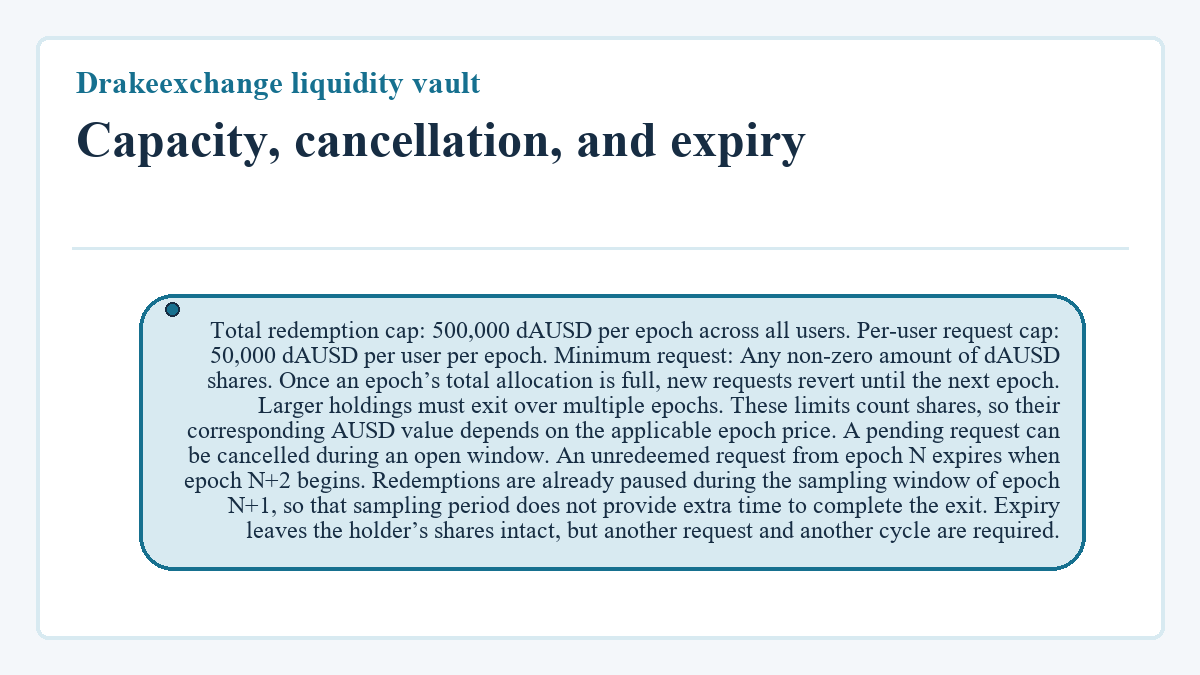
- 500,000 dAUSD per epoch across all users.
- Per-user request cap
- 50,000 dAUSD per user per epoch.
- Minimum request
- Any non-zero amount of dAUSD shares.
Once an epoch’s total allocation is full, new requests revert until the next epoch. Larger holdings must exit over multiple epochs. These limits count shares, so their corresponding AUSD value depends on the applicable epoch price.
A pending request can be cancelled during an open window. An unredeemed request from epoch N expires when epoch N+2 begins. Redemptions are already paused during the sampling window of epoch N+1, so that sampling period does not provide extra time to complete the exit. Expiry leaves the holder’s shares intact, but another request and another cycle are required.
The same shares at two epoch prices
All amounts, prices, and account states in this example are hypothetical. An eligible holder has an accepted request made in epoch N for 1738 dAUSD. Epoch N+1 is in its open redemption window, no vault pause prevents redemption, and its fixed price is 1.028 AUSD per dAUSD.
Redeeming burns the 1738 shares. The calculation is
1738 * 1.028 = 1786.664
, giving redemption proceeds of 1786.664 AUSD.
Keeping the requested share count unchanged but using a hypothetical fixed epoch price of 0.988 AUSD per dAUSD gives
1738 * 0.988 = 1717.144
AUSD. The lower price reduces the proceeds by 69.52 AUSD. Submitting the request therefore leaves the eventual AUSD amount exposed to the price established for redemption.
While the request remains pending, cancellation is available during an open window. If epoch N+1 has entered sampling, redemption is unavailable; an unredeemed request expires at the start of N+2. The holder then retains the shares and must request again. Neither a favourable price nor an accepted request removes the need for a valid redemption window.
Points associated with vault deposits
Eligible vault deposits qualify for Drake Points under the programme’s regional and anti-abuse rules. Activity weights can change between weekly periods. Points are an activity score with no cash value and are separate from dAUSD ownership and vault performance. Under the MON Rewards rules, vault deposits do not earn MON.