 Drakeexchange
: limits on margin changes
Last updated -
Drake Exchange is a perpetual futures exchange on Monad mainnet. Reducing an isolated position’s margin must leave its margin ratio at least 120%, while withdrawing from a cross-margin account must leave the account’s ratio at least 150%. These checks apply to the equity remaining after the change.
- Margin asset
- AUSD in both isolated and cross margin.
- Access restrictions
- App access is blocked from restricted locations, including the United States.
How the margin ratio is calculated
The margin ratio measures equity against maintenance margin, expressed as a percentage:
margin ratio (%) = equity / maintenance margin * 100
. Its scope depends on the account mode.
- Isolated position equity
- The position’s allocated margin plus unrealised profit or loss, minus unpaid funding and borrowing charges.
- Cross account equity
- The account’s AUSD balance plus unrealised profit or loss across its positions, minus unpaid funding and borrowing charges.
- Maintenance margin
- 3% of the isolated position’s notional at the oracle price, or 3% of the combined oracle-valued position notional in a cross account.
The 120% and 150% removal thresholds therefore compare remaining equity with maintenance margin. They do not describe the percentage of a deposit that can be withdrawn.
Different checks govern opening, removal, and liquidation
| Check | Isolated margin | Cross margin |
|---|---|---|
| Opening or increasing exposure | Available margin must cover notional divided by leverage plus the fee. The position must remain above its liquidation threshold after the fill. | Available funds must cover notional divided by leverage, and the account margin ratio must be at least 120% after the fill. |
| Removing collateral | The position margin ratio must be at least 120% after the reduction. | The account margin ratio must be at least 150% after the withdrawal. |
| Liquidation | The position becomes liquidatable at a margin ratio of 110% or below. | The account becomes liquidatable at a margin ratio of 110% or below. Liquidation closes all its positions. |
Removing collateral reduces equity without reducing the existing position size. The removal check consequently uses the remaining equity against maintenance margin for that exposure. A ratio above the liquidation threshold alone does not establish how much collateral can be removed.
Cross margin also has different thresholds for increasing exposure and withdrawing collateral. Its 120% after-fill requirement cannot be substituted for the 150% after-withdrawal requirement.
Fees and prices change the available buffer
Unpaid funding and borrowing charges enter the equity calculation. Their accumulation can reduce the buffer available for removing collateral even when position size stays unchanged. Oracle-price movements also affect notional and unrealised profit or loss.
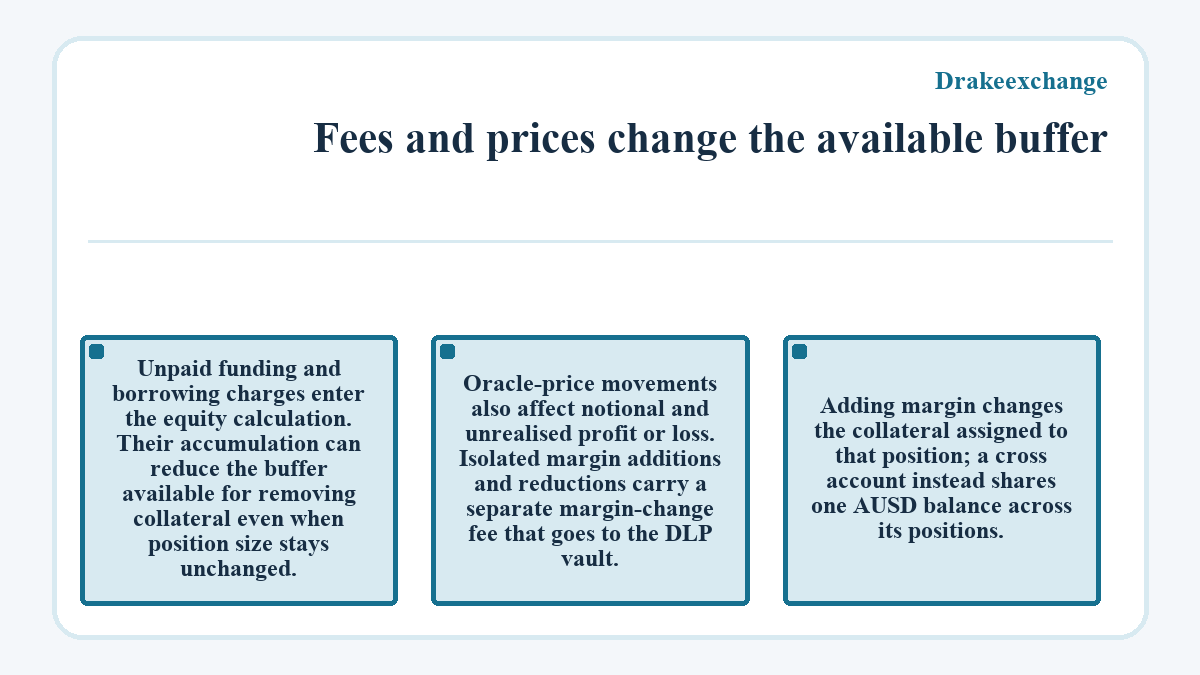
Isolated margin additions and reductions carry a separate margin-change fee that goes to the DLP vault. Adding margin changes the collateral assigned to that position; a cross account instead shares one AUSD balance across its positions.
Leverage limits and emergency mode
Governance can lower a market’s maximum leverage. That change does not force existing positions to close, but those positions cannot be increased beyond the new limit. Market states are managed separately for isolated and cross margin, and trading can be paused globally.
Governance can also place an individual account in emergency mode. The account may then submit only reduce-only orders, and its existing resting orders are cancelled. An emergency withdrawal is available only once the account is flat, with no open positions.
Decision checklist
- For an isolated margin reduction, assess the individual position and require a post-change margin ratio of at least 120%.
- For a cross-margin withdrawal, assess the shared account and require a post-withdrawal margin ratio of at least 150%.
- Include unpaid funding and borrowing in equity, and account for the separate fee on isolated margin additions and reductions.
- If emergency mode applies, an emergency withdrawal requires the account to have no open positions.